
Dance can be the most sophisticated articulation of the human body as it moves through space and time. For many casual observers and dance audiences, what is being observed may or may not communicate any messages, or project any specific histories or recall ancient stories; for dance, contrary to popular belief, is not created within a universal dance vocabulary. It’s an art form that has been evolving for centuries and has its own nuances, subtleties, minimalist or macro movements and meanings, depending on its environment. In the creative and skillful hands of its teachers, dancers, choreographers, and spiritographers,1 dance practice manifests itself as performance art. However, dance can also reflect and recall much of what has been mentioned above and be very compelling and provocative: weaving stories and tales underpinned by a range of specific societal values and norms; being more meaningful and reflecting common experiences embedded in specific societies and cultural environments. But dance—its vocabulary, repertoire and presentation style—remains culture specific, in spite of its evolutions and manifestations in new environments.
Black dance, in this context, will be used interchangeably with African and Caribbean dance to refer to the dance practices from the African continent and the African diaspora, especially as the forms evolved during the last decades of the 20th century.
*
Dance is not a recent phenomenon, either, and Black bodies in dance have been dancing for centuries. However, and especially since the 16th century and particularly when white Europeans arrived on the African continent, Black bodies in dance have never found favour with the majority of their European colonisers. White foreigners to West Africa’s coastal regions who witnessed dance gatherings reported that they were lewd, licentious, bawdy, and displeasing. Of course, within the African context, those Black bodies were self-defined: dancing bare-breasted or bare-chested, barefoot, and with stylish and sensual hip movements. Traditional dances were valued and respected; the performances at community gatherings and social occasions were inclusive, and inherent within those dance celebrations were shared community values. Dances had purpose, strengthening community bonds, and had profound meanings and messages for its specific communities. Through European lenses, the people and their dance practices were “otherised” and dismissed. The vast majority of European accounts, including the British, reported about African culture in negative terms. Those early, ill-informed writings, combined with the growth of global racism, congealed over the years to ensure that Black bodies in dance were positioned less favourably than their white counterparts in most forms of what can be considered Western “white dance”.
Interestingly, as historical records inform us, there was also a subtext related to many whites who were writing about, observing and “otherising” those Black bodies in motion: the same Black bodies that displeased, publicly, satisfied both male and female Europeans privately.
Europeans, from the very outset in their expansionist roles, were interested in the continent of Africa as an outpost to exploit economically and create wealth for Europe. They were not interested in “the dark continent’s” cultural or religious traditions and values. To gain maximum benefits, white Europeans created a hierarchical structure, positioning themselves and their values at the top and placing Africa’s populations in the lowest echelons of Europe’s world view. Unaccustomed to and uninterested as they were in African spirituality and religious and cultural practices, they positioned European cultural activities, in my parlance, as “haughty” culture, whilst to them African cultures were “naughty”.
Long after the first contact with Africans, well beyond the years of enslavement and the “scramble for Africa” (Berlin Conference 1884/1885) and even up to today, the Black body in dance is still “otherised” and viewed through distorted lenses by writers with Europeanist viewpoints. In spite of this, across the dance spectrum, Black bodies in dance still have the power to engage all sections of society and, depending on one’s particular vantage point, dancers continue to create and innovate, displease and seduce, anger and please, excite and entertain. Black dancers continue to distill quality choreographies and spiritographies, experiment and break boundaries, set new standards, create new and highly technical vocabulary, and captivate new audiences. Nonetheless, for all the individual training, skills, techniques, technological advancement, debates and analyses, Black dance practice has largely remained misunderstood and marginalised on the periphery of British society.
How did African and Caribbean dance traditions emerge in the UK?
In order to truly understand the emergence of African and Caribbean dance practice in the UK, and indeed globally, one has to start on the continent of Africa, to decipher and deconstruct the misrepresentations of European historians and early writers of the continent and reappraise, reconstruct and revalue the deep meanings that dance had and has for its communities. Following enslavement and colonisation, Black people migrated within the Americas, to Europe and further afield. Many from the Caribbean focused on a new life as they travelled and settled in the “motherland”, England. Once again, history reveals that these migratory movements were not simply from the push to leave their islands but, more forcibly, it was through the pull from the “motherland” wanting a cheap pool of labour to help it rebuild its physical infrastructure and restart its economic growth following the Second World War.
Historical records confirm that there has been a Black population in the UK for several centuries, well before the 1940s. Always shunted to the periphery of mainstream society, those small communities, living mainly in London, were generally employed as servants, maids, nannies, occasionally as musicians, and some worked in the sex industry. Despite their lowly position in mainstream white society, those Black communities entertained and enjoyed themselves. In particular, they danced at sacred and secular occasions, recalling from their physical and mental reservoirs music and movement that were steeped in religious practices, from Africa and creolised forms from the Caribbean. Although such occasions were visible and left a legacy, the foundation for traditional and contemporary Black dance practice in the UK was genuinely and firmly laid in the latter half of the 20th century.
For Africans, music and dance were not forms separated from daily existence; these were integrated into their religious practice. As Kofi Asare Opoku noted, “It is no exaggeration, therefore, to say that in traditional Africa, religion is life and life, religion.” Whilst Europe was amassing huge financial benefits from its horrendous treatment of Black bodies as cargo in the triangular slave trade, the world would later hugely benefit, culturally, from those Black enslaved bodies who would introduce a raft of innovations in music, dance, theatre, art, style, literature, science, etc. into Western cultural arenas. The resilience and resistance of enslaved Black bodies were also transporting, in opposition to the triangular slave trade, Africa’s intangible cultural traditions by creating cultural heritage circles,2 especially through religious practices. African dance—and drumming—not only survived but thrived!
Across the Caribbean, one of the first lines of cultural suppression was the banning of drumming and traditional dancing by European governments, as they considered those to be dangerous. Figure 1. shows the numbers of acts passed on various islands to outlaw drumming and dancing.
Number of Acts Passed in the Caribbean
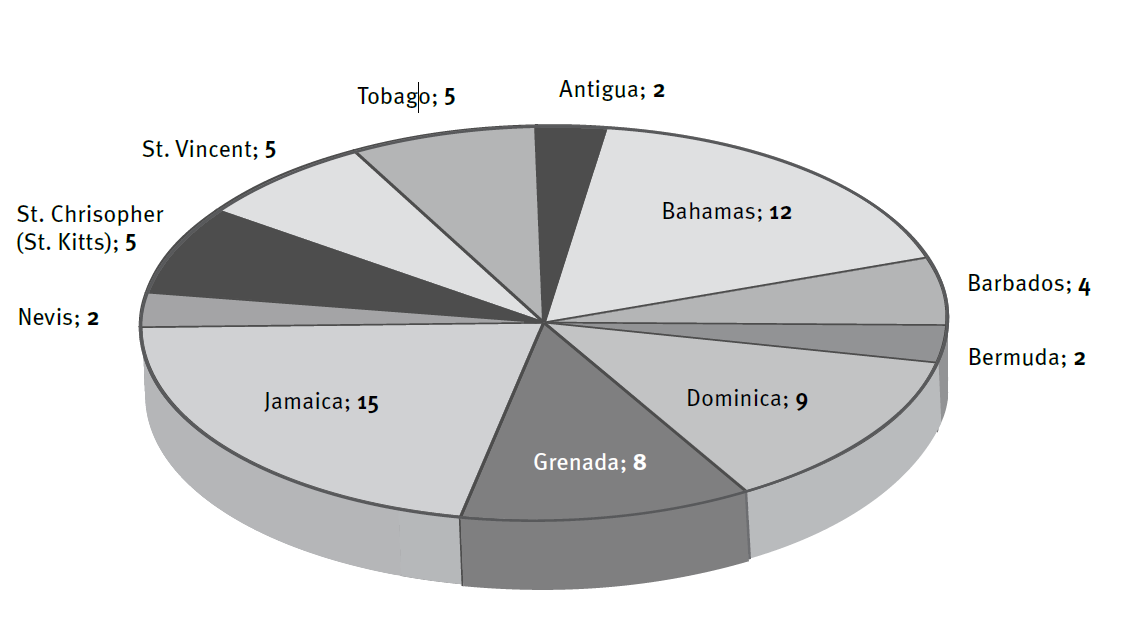
Figure 1.
The drum was considered dangerous because, in African traditions, rhythmic percussion and communal movement were weapons of communication and mobilisation. Dangerous, because African communities used drumming to call upon and engage ancestors, coordinate resistance, and reinforce social bonds beyond colonial control.
In Jamaica, the colonisers were continuously being harassed by the Maroon communities whose coded drumming, singing and dancing underpinned several rebellions. Plantation owners feared those rhythms, knowing that they were being used as signals for local uprisings. In failing to understand or value African culture, European colonisers failed to understand that dance was encoded with voice and memory, and to suppress it was to suppress identity itself—a next to impossible undertaking. Africans resisted and danced Kumina, bruckins, Jonkonnu and more.
Despite systemic repression, the enslaved and the free communities improvised, innovated and developed percussive alternatives using saws, sticks, bamboo, and clapping. In the twin-island state of Trinidad and Tobago, tamboo-bamboo and kaiso singing (early forms of calypso) emerged from hidden gatherings where movement and song blended memory with coded commentary. In Cuba, enslaved West Africans preserved their musical heritage within Catholic rituals, giving rise to Santería, a syncretic religion combining Yoruba orishas with Catholic saints and with music and movement; whilst in Brazil, capoeira, a dynamic, highly styled martial art, combined elements of dance, acrobatics, music, and spirituality as a form of resistance and self-defence.
Enslaved Africans in Haiti wove together West and Central African spirits with Taino elements and Catholic iconography, establishing voodoo on the island, and in Barbados the Land-Ship had strong connections to British naval manoeuvres, but it was also coupled to core West African cultural traditions of community cohesion for social and economic prosperity. Dance, linked to religious practices, was central to the existence of life on all the Caribbean islands. The coloniser’s attempts to ban drumming and dancing were dual in purpose, meant to stifle any resurfacing of Africa’s cultural traditions in the Caribbean whilst at the same time strengthening the coloniser’s political acts of control. Enslaved and free communities responded with adaptation: dance continued clandestinely, disguised within church festivals, hidden in plantation fields, and reshaped through syncretic spiritual practices.
In spite of the consistent European attack on and negation of this art form, Black dance practice across the Americas has weathered the blistering of European critics. Dance has evolved into several tangible styles that continue to share narratives of “the other” through dynamic choreographies and spiritographies; through dances of resistance and rebellion; and through musical theatre, in street dances and in films. Whether in social, religious or ceremonial functions throughout the African continent and around the world today, Black dance is alive and kicking! This body articulation, transformed and embodied in the souls and spirit of the enslaved, was resurrected, reformulated and re-energised in the Americas on tobacco, cotton and sugar cane plantations, and it now finds expression in theatres, art centres, concert halls, community centres, places of worship, village halls and street pavements across the Americas North and South, across Europe, throughout the current and former English, Spanish, Dutch, French, and Danish Caribbean, and the wider global stage.
As Black people of Africa and the Americas migrated to Europe and elsewhere in search of a better life, their cultural retentions manifested themselves in a range of artistic endeavours, including dance. Such was the case in the UK as Caribbean immigrants, African Americans and continental Africans arrived there centuries ago. Why and how this persecuted art form established roots in the UK several centuries earlier speak to the significance and meaning dance has for its Black communities. Who were the key players, who like their forefathers found opposition to their mere presence in the UK and an accompanying resentment of their art forms in contemporary Britain, but who overcame those to lay a foundation for the continuity of Black dance practice in the UK today? Why did they want to do that anyway, given the struggles of daily life itself and the difficulties and racist attacks that the Black communities were facing, not only in the arts, but in their lives generally, especially in employment, education and housing? Why indeed, after all the centuries of observation of Black bodies in dance in Africa, throughout the Americas and in the UK itself, is there no published history of the contribution of these dancers to the cultural life of Britain?3
The early pioneers, in the sense of establishing formal groups and devising and choreographing theatrical dance, were Berto Pasuka and Richard Riley from Jamaica (1946), Boscoe Holder from Trinidad and Tobago (1950), Allister Bain from Grenada (1958), Elroy Josephz from Jamaica (1960), and Jeanette Springer from Guyana (1970). The Ghanaian Felix Cobbson (1965) had established the Aklowa Centre, offering training programmes and performances in Ghanaian drumming and dancing. Additionally, there were individual Caribbean entertainers, notably Cy Grant (Guyana) and Edric Connor (Trinidad) presenting concerts of traditional folk songs with calypso dancers, and informal groups of drummers and dancers who linked up to perform when the occasion demanded it. Visiting US-based companies and African American solo performers, notably Marie Bryant, a highly skilled jazz dancer, also performed “exotic African dances” in London in the 1950s.
On 30th April, 1946, a new voice emerged on the dance horizon as Les Ballets Nègres, and its charismatic leader and choreographer, Berto Pasuka, opened for their first season at the Twentieth Century Theatre in London. Pasuka laid the foundation for organised Black dance practice in Britain. Born in Jamaica of mixed parentage (African and East Indian), he arrived in England in 1939. His company exploded onto the London theatrical stage with four full-length ballets, unheard of during the period of Black dance development. Cy Grant, Allister Bain, Alex Pascall, Elroy Josephz, Evrol Puckerin, Jeanette Springer, Dorothy Palmer, Raymond McClean, and several others were presenting cabaret-style performances. Those performers were engaged in other forms of daily employment but continued promoting their cultural traditions, genuinely enriching and nourishing the lives of the British population who were still psychologically recovering from the recent war.
During the 1970s and 1980s, the Caribbean and African contribution to the British cultural landscape increased significantly through proponents like Peter Blackman and Carol Straker (Barbados), Carl Campbell, Hermin McIntosh, Chester Morrison, Jackie Guy, H. Patten, the Andersons (Lorna, Barry, Angela, Pauline, Jamaica/UK), Ben Baddoo, George Otoo, George Dzikunu, Emmanuel Tagoe (Ghana), Julia Mathunjwa, Betty Boo, Joe Legwabe, Chief Dawethi, Elliot Ngubane (South Africa), Ginger Johnson and Ambrose Campbell (Nigeria), Jeanette Springer (Guyana), Beverley Glean (Grenada), Tony Morgan and Kif Higgins (Liverpool), Greta Mendez and Evrol Puckerin (Trinidad and Tobago), and me, a Trinidadian arts manager and co-founder of three small community dance groups. This has been done through the continued teaching, performing and promoting of Black dance.
Caribbean and African dance forms flourished due to the desire and interest of young people; dance, our dance, was both the social and political framework within which Black people definitely said: I AM, WE ARE!! Shikisha, African Dawn, IRIE! dance theatre, Adzido Pan-African Ensemble, and MAAS Movers in London; Adinkra in Bristol; and Kokuma, Wantu Wanzuri and Danse de L’Afrique (DLA) in Birmingham were buzzing, and individual dancers and drummers, including Ben Baddoo, Felix Cobbson, Nicky Reid, Mario Diekuuroh, Stephen Blagrove, Norman Stephenson, Charles James, George Otoo, George Dzikunu, and Peter Blackman, among others, were offering workshops around the country.
Whereas most groups were involved in Caribbean and African dance practice—traditional and contemporary—and focusing on African dances, mostly from Ghana, the repertoires and vocabulary were added to toward the end of the 20th century with the arrival in the UK of Peter Badejo (Badejo Arts), Bode Lawal (Sakoba), both professionally trained dancers/spiritographers from Nigeria, and Patrick Acogny from France/Senegal.
Today Black bodies in dance can be seen across the Caribbean, in the UK and globally. Whatever the situation, Black dancing traditions continue, and in the UK today, Itara, a Barbadian, who has been dancing from the age of four, continues to share her limbo dancing skills!
Notes
1 Spiritographer/spiritography are words which I have coined to reinforce the fact that many creative productions by African and Caribbean creators of dance were/are inspired and influenced by both visible and invisible sources. I introduced this in my unpublished PhD thesis, African Dance in England—Spirituality and Continuity (University of Warwick, 2005), and more recently in my book, The Black Dance Movement in England 1940-2000.
2 Cultural heritage circles were intangible spiritual connections amongst Africans wherever they found themselves. Whilst Europeans were only interested in the Black African body as an economic asset, Africa’s intangible cultural heritage was being transmitted at the same time, evolving and contributing to cultural development in the Americas. Those traditions from Africa, throughout the periods of enslavement and beyond, linked up and strengthened African cultural practices in the Americas, the Caribbean and later in the UK, finally reconnecting directly with the source in Africa. Those invisible cultural heritage circles have endured for centuries, growing and expanding up to the present day.